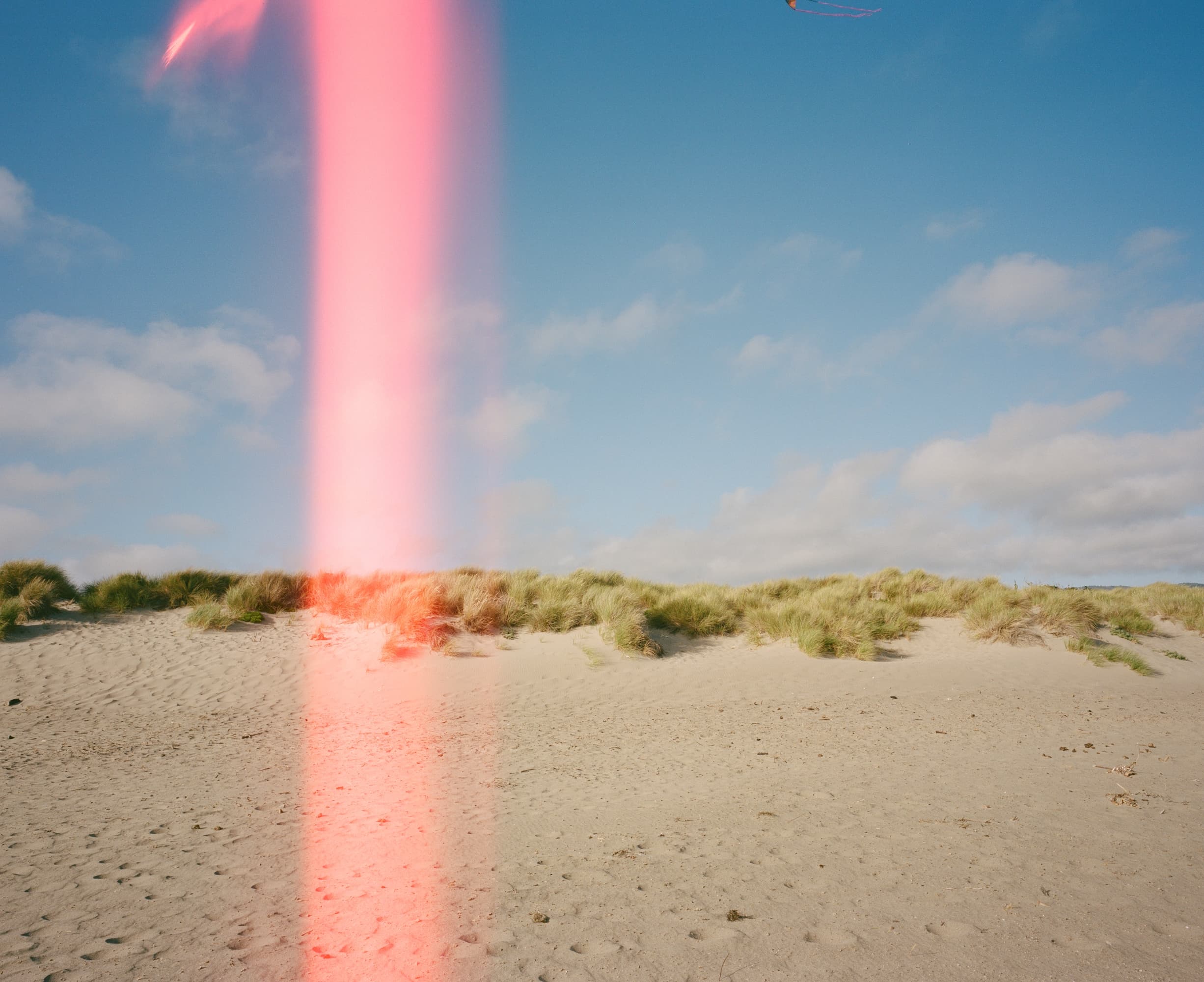
I saw it as a tidal wave.
Not metaphorically. I mean the image arrived whole. AI as a wall of water moving toward shore. The question everyone asks is: how do we survive the wave? How do we build the wall high enough? How do we outrun it? That is the wrong question.
Nature solved this problem a long time ago, not by resisting the water, but by growing into it.
Picture a coastline with nothing between the ocean and the land. Hard sand, then structures. When the wave hits, it breaks apart everything on contact. The force has nowhere to go except through whatever is in front of it. The water does not care what you built. It is energy looking for a path.
Most organizations are on this trajectory right now. AI arrives as raw force into organizations, industries, careers that have no living layer between themselves and the capability. The force erodes rather than enriches, not because it is malicious, but because there is nothing to metabolize it.
A seawall is the intuitive response. Centralized AI infrastructure. Guardrails. Compliance layers. Policies that say what the wave is allowed to touch. The seawall works until it doesn't. It is rigid by design. The wave is not. One day the water comes higher than the wall was built for, and the failure is total. Everything behind it was never adapted to water at all.
Now picture the Everglades. Or mangrove forests. Or river deltas. The zone where water meets land is not a line. It is a living system. Miles deep. An interwoven mesh of roots, organisms, sediment, nutrient cycles. The water enters this system and is not stopped. It is slowed, filtered, absorbed, redirected, and converted into fuel for the very system that buffers it.
The mangrove does not fight the tide. It grows because of the tide. The root system gets denser with each cycle. The ecosystem gets more complex. The boundary between water and land is not a wall. It is the most biologically productive zone on Earth.
Ecologists have a term for this: the ecotone. The boundary between two biomes. Forest meets grassland. River meets ocean. The ecotone is always more complex, more diverse, and more productive than either biome alone. The meeting of unlike forces does not produce chaos. It produces the conditions for the richest complexity.
This is not just metaphor. The structural pattern is thermodynamic.
Ilya Prigogine won the Nobel Prize for describing what happens when energy flows through an open system at the right rate. The system does not break down. It self-organizes. Order emerges from the flow. He called them dissipative structures: systems that maintain their complexity precisely because energy moves through them, not in spite of the energy, but because of it.
Too little energy, and the system is static. Nothing happens. Too much energy, too fast, and the system is overwhelmed. It breaks apart. But in the middle range, where force meets structure at a rate the system can metabolize, complexity increases. The system becomes more ordered, not less.
This is what the Everglades do with water. This is what a healthy ecotone does at any boundary. And this is what the living layer between AI and human work needs to do with intelligence.
Everywhere I look, the pattern repeats:
Complexity. Force plus structure plus a living layer between them. The force feeds the layer. The layer protects the structure. The structure gives the layer something to anchor to. All three in dynamic balance. This is the mangrove coast. This is Prigogine's dissipative structure. This is the architecture that grows stronger under pressure.
Erosion. Force plus structure, no living layer. The force hits the structure directly. The structure degrades. This is the unprotected shoreline. This is the organization that deploys AI with no infrastructure to metabolize it. The capability arrives raw and erodes what it touches.
Catastrophic forcing. Force exceeds the capacity of any buffer. The system is overwhelmed regardless. This is the scenario the doomsayers fixate on. It is real, but it is also the condition where no architecture helps. The useful question is not about the catastrophic case. It is about whether we are building for complexity or accepting erosion as the default.
The root system does not appear overnight. The mangrove forest that can absorb a storm surge in 2026 started growing decades ago. Each tide deposited a little more sediment. Each cycle let the roots extend a little further. The daily, unremarkable interaction between water and roots built the resilience that handles the extraordinary event.
The same is true for the living layer between AI and human work. Every day that a practitioner works with AI inside a system that captures what happens, that feeds real outcomes back into the architecture, that lets the human judgment and the machine capability shape each other: that is one more root in the ground. One more branch in the mesh. The system that can absorb tomorrow's slightly larger tide is being built by today's ordinary work.
You cannot build the Everglades the week before the hurricane. You grow them over years of normal tides.
The instinct to centralize is strong. Build a big wall. Control the access points. Decide from the top what the water is allowed to do. This is the enterprise AI strategy. The compliance-first, platform-controlled, vendor-mediated approach. It works in the sense that seawalls work: for a while, for waves up to a certain height, at the cost of everything behind the wall remaining unadapted.
The alternative is not chaos. It is the wetland. Decentralized, rooted in real work, fed by the very force it buffers. Every node in the system (every practitioner, every team, every organization running their own AI-integrated practice) is a root cluster. The mesh between them is the shared infrastructure. The intelligence flows through the mesh, is shaped by each node's unique context, and deposits value as it moves.
The wetland does not need a central authority deciding where the water goes. The water goes where the roots are. The roots grow where the water is. The system self-organizes because the architecture makes self-organization the path of least resistance.
What convinced me this is real, and not a framework I am projecting onto the world, is that other people are arriving at the same place from completely different directions.
Rohit, an engineer focused on agent reliability, published that the model is almost irrelevant; the environment it operates in determines outcomes. Jay Scambler built a recursive self-improvement system and discovered that without real evaluation feeding back into a persistent knowledge base, the system degrades into noise. These are people solving narrow technical problems who arrive at the same structural insight: the living layer between the intelligence and the work is what matters.
None of them coordinated. None of them read the same paper or drew the same conclusion. They are building different things in different contexts and landing on the same pattern, which is how real patterns tend to announce themselves: not through persuasion, but through independent discovery.
I am not describing something that needs to be invented. I am describing something that is already growing. The root system is in the ground. The daily tides are doing their work.
The question was never whether a living layer would emerge between AI and humanity. Prigogine told us it would. The ecotone effect told us it would. The thermodynamics of open systems told us it would. Force meeting structure at the right rate produces complexity. That is not a hope; it is physics.
The question is whether we cultivate the conditions for healthy emergence or let the force erode the shore while we argue about the height of the wall.
I have been running an operating system built on this principle for two months. The machines handle execution. I handle judgment. The system captures what happens, feeds it back, and grows more capable with each cycle. It is small, and it is already working.
I know which one I am building.
The ideas in this article originated with James Bogue, sparked through ongoing reflections and conversations within the House of Bogue operating system. The OS is a continuously running practice where human judgment and machine intelligence evolve together through real work. The system complements the thinking with research, structure, and language that help convey what the author sees. This article is co-written from those interactions, a natural artifact of the process itself. All final edits and editorial judgment are the author's.
James Bogue